How Many House Fires Are Caused by Dryers? (NFPA Stats Explained)
Understand dated NFPA dryer-fire estimates, why washer totals differ and how to use statistics without presenting historical figures as 2026…
Read More »
Dryer Vent Cleaning
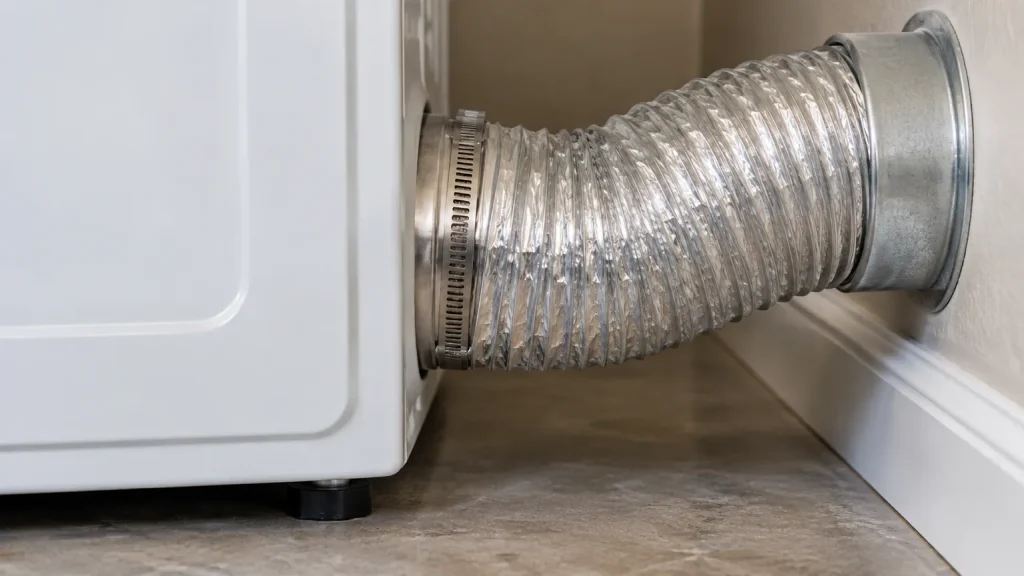
Connecting a dryer to the vent is more than joining two visible openings. The transition behind the appliance has to suit the equipment, route and available clearance.
This guide explains what to verify before an installation or reconnection. It does not replace the manufacturer's instructions or applicable local installation requirements, and it is not a tutorial for gas-line or electrical work.
Identify the recommended exhaust connection, material and arrangement for the dryer model. Keep the installation manual available for the person performing the work.
Do not assume an old connector is appropriate because it fits the opening. A replacement appliance or changed laundry layout can alter the clearance and connection needs. Ask the installer to confirm the whole arrangement rather than reusing a questionable part by default.
The dryer must connect to its intended outdoor exhaust path. An unfamiliar wall opening should be assessed before attachment. Do not confuse a room return, another appliance exhaust or an unused cavity with a suitable dryer line.
If the route is concealed, obtain available builder or service records. An installation assessment can help clarify uncertainty about where the line terminates and what condition it is in.
Pushing a dryer tightly against a wall can change the shape of the transition. Before final positioning, the installer should confirm that the connector remains properly arranged.
A tight closet, stacked machine or door that closes against the appliance may require a different layout. Cleaning lint from a repeatedly compressed connection does not correct the space problem causing recurrence.
An appliance fuel connection needs appropriate handling. Do not pull a machine forward, twist a fitting or disconnect a gas line as an improvised way to improve vent access. Use qualified assistance where utility connections are involved.
Use the specified parts and approved methods for the equipment and local requirements. A product described generally as flexible venting is not automatically suitable for every portion of the route.
Ask the installer to distinguish the visible transition from permanent concealed ductwork. Confirm that the chosen arrangement does not introduce an unsuitable material or obstruction. This is especially important when a new dryer is connected to a system whose construction is unknown.
A correct appliance connection cannot solve every problem farther along the exhaust route. A damaged termination, nest, disconnected section or concealed restriction may need separate attention.
If the dryer is being replaced because of repeated long drying cycles, record that history. Do not assume new equipment eliminates an existing vent problem. Ask whether the line should be inspected before normal operation resumes.
The person cleaning the exhaust and the person making a utility or installation repair may have different scopes. Ask who is responsible for each finding and what will be documented at completion.
For questions about dryer vent cleaning, call Brookstown Duct Cleaning at (336) 817-0075. Describe the connection and any recurring symptoms, and ask whether cleaning or an installation assessment should come first.
Use the dryer manufacturer's installation instructions and applicable local requirements. Confirm the route, suitable parts and clearance with an appropriately qualified installer rather than improvising.
Have its material and condition checked first. A part that physically fits may still be damaged or unsuitable for the replacement equipment and available space.
The transition can become compressed or distorted if clearance is inadequate. The final positioned appliance needs a connection that remains properly arranged.
It can create a repeated installation defect. Clearing lint alone may not fix a connector that is compressed whenever the machine is returned to position.
No. Confirm the intended route and outdoor termination. An unfamiliar cavity or another system opening should not be assumed suitable.
Do not disturb unfamiliar fuel connections during vent work. Ask an appropriately qualified provider to handle utility-related access or installation tasks.
They serve different portions of the exhaust arrangement. Ask the installer to explain the appropriate material and method for each section.
Yes, particularly when its condition or route is uncertain or earlier drying problems persisted. New equipment does not automatically correct an existing line defect.
Ask for the connection scope, parts used, route information and unresolved findings. Keep those records with the appliance manual and maintenance history.
Call (336) 817-0075 about lint-related exhaust concerns or maintenance history. Ask whether cleaning fits or whether installation or appliance work needs a separate provider.
Talk to a locally owned Winston-Salem team for a clear quote and a thorough, clean job.
Understand dated NFPA dryer-fire estimates, why washer totals differ and how to use statistics without presenting historical figures as 2026…
Read More »Plan dryer vent maintenance using manufacturer guidance, laundry use, route condition and warning signs. Learn what a useful service record…
Read More »Understand dryer lint and exhaust concerns, recognize warning signs and learn why cleaning, repairs and safe appliance use all belong…
Read More »