Why Is My House So Dusty? 9 Causes (Including Your Ducts)
Explore why is my house so dusty with practical checks, clear service limits and 10 FAQs for Winston-Salem homeowners.
Read More »
Air Duct Cleaning
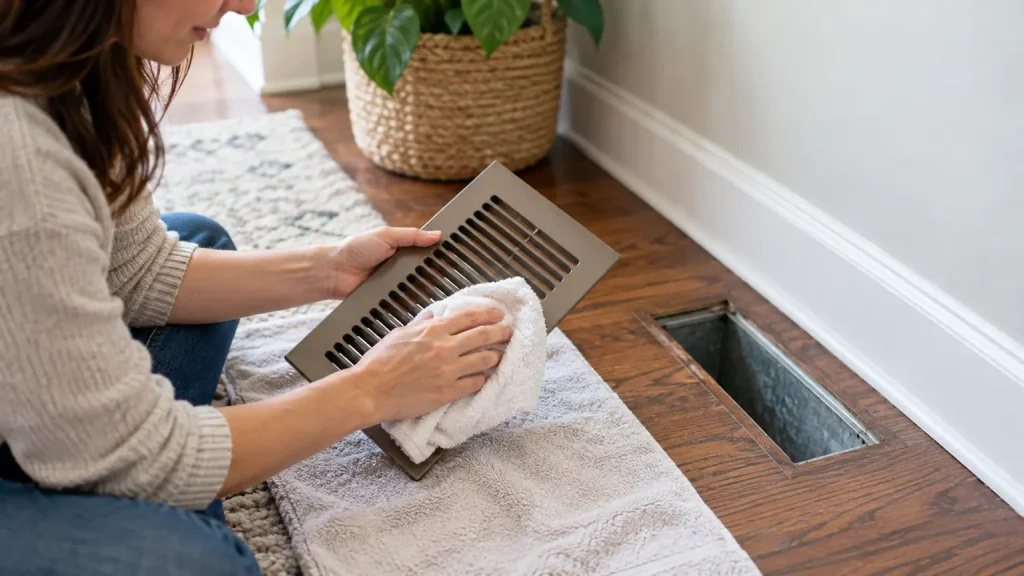
If you search how to clean ductwork, you will find tasks ranging from wiping a grille to using specialized equipment inside concealed air pathways. Those are different scopes, and confusing them can make a DIY job riskier than expected.
This article focuses on choosing an appropriate boundary. It does not provide instructions for dismantling equipment, cutting access holes or forcing household tools into unknown ducts.
A removable grille, an accessible boot and a concealed branch are different components. The first may be a routine surface-maintenance task; the others can require knowledge of material, connection and access.
Locate the equipment instructions and understand what is safely accessible. Avoid entering moving, electrical or sealed equipment areas. If a component is unfamiliar, an assessment is more useful than copying a demonstration from a different system.
Bare metal, flexible duct and internally lined sections should not be treated as interchangeable surfaces. A method that looks effective in one setting can damage a different construction. Ask a provider how the material will be identified and protected.
Follow appropriate instructions to remove ordinary dust from reachable grille faces and adjacent room surfaces. Keep debris from falling into the opening during the task and restore any component correctly before operation.
Do not assume that this housekeeping clears the connected branch or establishes whole-system condition. Record anything unusual rather than extending the task into concealed sections with improvised tools.
If you find wet material, suspected contamination or pest evidence, stop treating the work as ordinary surface dust. Those conditions may need a separate plan and source correction.
A household vacuum or brush cannot establish the layout of an unknown route. You may remove local material while leaving the main pathway untouched, or loosen a connection you cannot see.
Do not cut into ductwork to improve access or use a tool aggressively where its position is uncertain. Avoid spraying deodorizer or disinfectant into openings. A fresh smell does not document debris removal and can make source investigation harder.
Request a component-specific explanation of collection equipment, agitation methods and room protection. Ask how the method suits the system's material and how openings are restored after the job.
The proposal should distinguish cleaning from repairs. A broken connection, wet liner or recurring source may require corrective work before or alongside cleaning. A more powerful machine does not automatically solve those defects.
Photograph accessible conditions without reaching into the duct. Note recent construction, attic work, leaks or pest reports. Record whether material comes from one supply or several, and whether the issue began after a known event.
These details help decide where to inspect. They are more useful than a general assumption that every home needs the same level of service.
If the task is ordinary reachable surface maintenance, keep it within that boundary. If the issue involves concealed debris or a documented contamination event, request an inspection and written scope.
Discuss residential air duct cleaning with Brookstown Duct Cleaning at (336) 817-0075. Explain what you observed and ask which components need attention before approving a whole-system job.
Accessible surface maintenance may be appropriate when instructions and safe access are clear. Concealed duct cleaning requires a different understanding of material, layout and equipment.
No. It addresses only the area reached. It does not establish the condition or cleanliness of concealed branches and main runs.
Do not force tools into an unknown route. Stop when location, material or resistance is uncertain so you do not damage an unseen connection.
Cleaning methods should suit the surface. Flexible or lined material may require different precautions from bare metal, and a damaged section can need repair or replacement.
Do not improvise concealed-system access. Ask a qualified provider how necessary access will be created and properly restored for the specific installation.
Avoid improvised products inside the air pathway. Identify the source and ask whether any proposed treatment is appropriate for the material and condition.
Stop treating it as routine dust. Document the finding and arrange moisture-source and material assessment before assuming cleaning will solve it.
The contractor should explain how it collects identified debris, protects the system and fits the component scope. Machine size alone is not a completion standard.
Record accessible findings, affected registers and recent events. Keep photographs and maintenance records without dismantling equipment to obtain additional evidence.
Call Brookstown at (336) 817-0075 to discuss the observed concern. Ask whether accessible maintenance, inspection or professional cleaning is the suitable next step.
Talk to a locally owned Winston-Salem team for a clear quote and a thorough, clean job.
Explore why is my house so dusty with practical checks, clear service limits and 10 FAQs for Winston-Salem homeowners.
Read More »Check filter instructions, fit and condition to plan replacements. Learn how air-filter maintenance differs from diagnosing dirty ducts or equipment…
Read More »Explore why is my room so dusty with practical checks, clear service limits and 10 FAQs for Winston-Salem homeowners.
Read More »