How Many House Fires Are Caused by Dryers? (NFPA Stats Explained)
Understand dated NFPA dryer-fire estimates, why washer totals differ and how to use statistics without presenting historical figures as 2026…
Read More »
Dryer Vent Cleaning
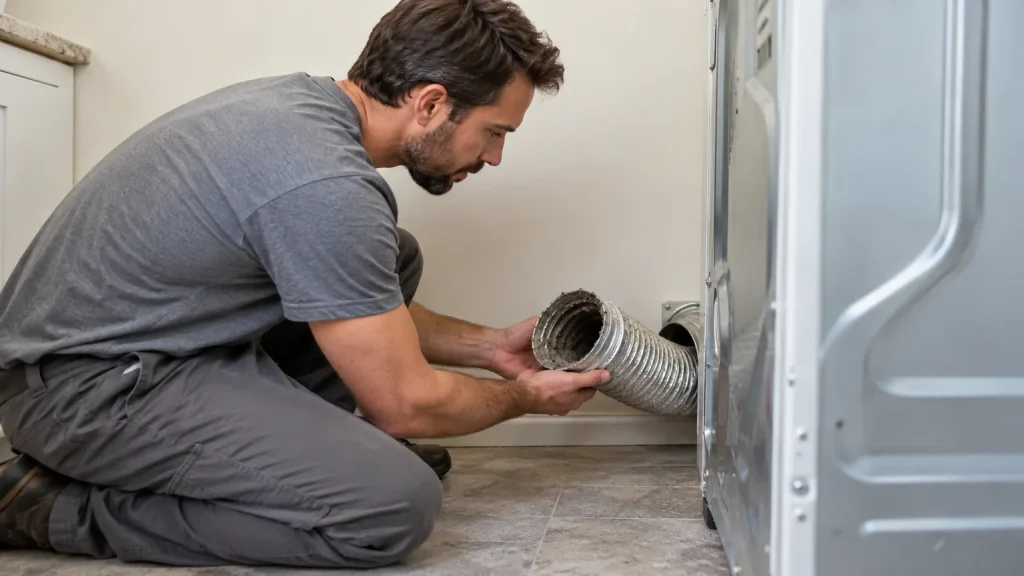
Learning how to clean a dryer vent begins with knowing which parts are safely accessible. A lint screen, an exterior hood and a concealed exhaust line are not interchangeable maintenance tasks.
This guide explains a cautious preparation and inspection sequence. It is not permission to disconnect gas fittings, enter concealed spaces or work on a roof. Follow the dryer manufacturer's instructions and stop if the equipment or route is unfamiliar.
Locate the manual and confirm the recommended maintenance procedure. Note where the dryer sits and where the exhaust terminates outdoors. If the route cannot be identified, a professional assessment is more useful than inserting a brush into an unknown pathway.
Check whether the appliance is gas or electric. A fuel connection requires appropriate handling; an ordinary vent-cleaning task should not disturb it. Heavy or stacked appliances also need an access plan rather than improvised movement.
Follow the manufacturer's shutdown and power-isolation instructions before any maintenance. Allow the equipment to cool. Keep children and pets away from the work area and do not operate the machine with an unfamiliar disconnected exhaust arrangement.
If the manual does not give a safe procedure for the task you intend to perform, ask a qualified provider. A video showing a different dryer or connector does not establish the correct method for yours.
Smoke, active fire, a gas-like odor or an electrical burning smell requires an appropriate safety response. Do not use repeated dryer operation to see whether a concern disappears.
Maintain the lint screen according to the appliance instructions. Inspect the accessible area without reaching into moving or electrical components.
At a safely reached ground-level exterior outlet, note visible lint, damage or a flap that appears obstructed. Do not remove an unfamiliar guard, disturb wildlife or force a tool into a concealed route. A loose item at the opening can be removed only when doing so is safe and consistent with the installation instructions.
A homeowner brush kit is not suitable for every exhaust installation. Concealed turns, fragile or disconnected sections and roof outlets can make an improvised cleaning attempt unreliable.
Do not assume that feeding a brush farther means the line is being cleaned completely. If a tool meets resistance or its location is uncertain, stop rather than force it. A lost brush or loosened connection can create a new problem.
For long, high or unfamiliar runs, professional equipment and access planning are more appropriate. The contractor should explain how the full route is assessed and what repairs remain outside cleaning.
Any disconnected or repositioned component must be restored correctly before use. If you are unsure about the connector, material or appliance clearance, get qualified help.
A crushed transition, damaged outlet or incorrectly routed line is not solved simply by clearing loose lint. Ask whether repair or installation correction is needed. Keep cleaning and corrective work separately identified in the proposal.
Note the maintenance date, accessible findings and any professional service. If drying remains slow afterward, review appliance performance and other causes rather than assuming the vent must need another cleaning immediately.
For dryer vent cleaning in Winston-Salem, call Brookstown Duct Cleaning at (336) 817-0075. Explain the route and access conditions so the work can be planned safely.
Some accessible maintenance may be suitable when the manufacturer's procedure is clear. Concealed, high, damaged or unfamiliar routes need a different plan and may require professional service.
Do not disturb an unfamiliar fuel connection as part of DIY vent maintenance. Ask an appropriately qualified provider to handle access and any gas-related work.
No. The screen and the line beyond the appliance are different components. A clean screen does not establish that concealed exhaust sections are clear.
It provides one accessible observation, but does not reveal every interior turn, connector or obstruction. Record the finding without treating it as a complete system inspection.
No. Route construction, access and condition matter. Stop if the tool meets unexplained resistance or its location is uncertain rather than forcing it farther.
Stop the attempt and arrange appropriate help. Do not keep operating the appliance or use increasing force on an unknown concealed connection.
Do not treat roof access as an ordinary homeowner task. Explain the termination location to a provider who can plan suitable equipment and safe access.
No. The damaged or unsuitable arrangement needs correction. Repeated cleaning can leave the reason for restricted exhaust unchanged.
Review the completed scope and appliance operation. Load, cycle selection, washer spin performance and dryer faults can also contribute to damp clothing.
Call Brookstown at (336) 817-0075 and describe the appliance position, known outlet location and observed changes. Mention tight closets, stacked machines and difficult access.
Talk to a locally owned Winston-Salem team for a clear quote and a thorough, clean job.
Understand dated NFPA dryer-fire estimates, why washer totals differ and how to use statistics without presenting historical figures as 2026…
Read More »Plan dryer vent maintenance using manufacturer guidance, laundry use, route condition and warning signs. Learn what a useful service record…
Read More »Understand dryer lint and exhaust concerns, recognize warning signs and learn why cleaning, repairs and safe appliance use all belong…
Read More »