How Many House Fires Are Caused by Dryers? (NFPA Stats Explained)
Understand dated NFPA dryer-fire estimates, why washer totals differ and how to use statistics without presenting historical figures as 2026…
Read More »
Dryer Vent Cleaning
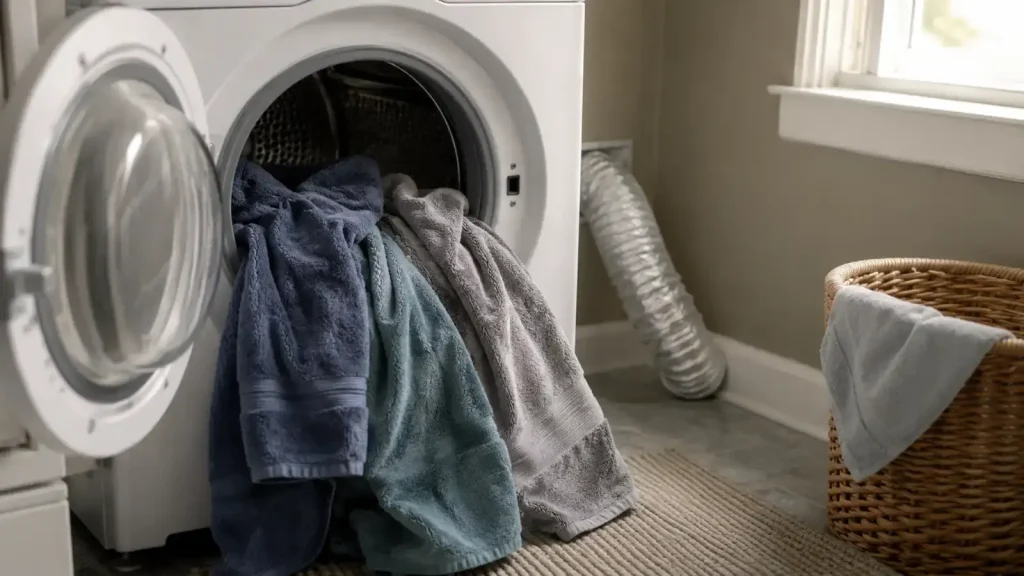
A dryer can seem perfectly normal through months of lighter laundry, then suddenly struggle when towels, bedding, sweatshirts, pet blankets, or turnover linens enter the rotation.
The change may look like an appliance problem, but heavier loads can also expose an airflow restriction that lighter loads were masking.
That matters during seasonal laundry surges, property turnovers, busy household routines, and periods when bulky fabrics become more common.
A dryer needs enough heat, tumbling space, and exhaust airflow to remove moisture. When one part of that process weakens, heavier loads usually reveal the problem first.
Bulky, moisture-heavy laundry puts more demand on the same dryer and exhaust path, making small performance losses easier to notice.
Towels, blankets, denim, sweatshirts, pet bedding, and thick linens can carry substantially more water into the dryer than lightweight clothing. They also need enough room to tumble so that heated air can move between items.
If you have recently shifted from light summer clothing to heavier fabrics, increased household laundry, or started processing larger turnover loads, some increase in drying time may simply reflect the load itself.
The warning sign is a bigger change. Clothes that previously dried reliably may begin needing another cycle, remain damp at seams and waistbands, or feel hot without becoming fully dry.
A dryer does more than heat clothes. It must move humid air out through the exhaust system. Lint and debris inside that path can reduce airflow gradually.
A minor restriction may not be noticeable with a small load. Add several wet towels, and the dryer must remove much more moisture through the same narrowed exhaust path. That is when a clogged dryer vent or other airflow restriction becomes easier to detect.
For a closer look at how seasonal laundry demand affects the exhaust path, see how summer laundry can leave a hidden lint backlog.
Need the exhaust path evaluated instead of guessing whether the dryer is failing? At Brookstown Duct Cleaning, we clean residential dryer vent systems using professional tools and inspect the vent path for airflow restrictions. Call 336-817-0075 to request a free estimate.
Slow drying is a symptom, not a diagnosis. Comparing the load, airflow, heat, and appliance behavior helps narrow down the cause.
Lint accumulation happens gradually. The dryer may compensate until airflow drops enough that moisture can no longer leave efficiently during demanding loads.
The U.S. Fire Administration reports that failure to clean was the leading factor in 31% of home clothes-dryer fires from 2018 through 2020.
That does not mean every slow dryer represents an immediate fire, but it makes unexplained airflow changes worth investigating. Dryer fire prevention guidance also reinforces the importance of dryer maintenance.
Properties with repeated laundry cycles, pets, shared laundry areas, or tenant turnover may accumulate lint differently from low-use households. A turnover-focused dryer vent check can be especially useful when the previous maintenance history is unclear.
A crushed or sharply bent connector behind the dryer can limit airflow. The exterior hood can also become obstructed or fail to open properly.
You can safely observe accessible areas without dismantling the appliance. Look for:
Do not disconnect gas equipment, open electrical components, or reach into inaccessible vent routes unless you are qualified to do so.
Air needs space to circulate through wet fabrics. Packing the drum too tightly limits tumbling and creates dense areas where moisture escapes slowly.
Try separating one unusually large load into two reasonable loads. If drying performance returns to normal, load size may be a major factor.
If even moderate loads now take substantially longer than they used to, look beyond overloading.
Vent cleaning cannot repair every slow-drying dryer. Heating components, moisture sensors, controls, motors, and other appliance parts can affect performance.
A useful distinction is whether the dryer appears to produce normal heat but struggles to move moisture out. That pattern can support checking the exhaust path.
Little or no heat, abnormal noises, electrical problems, repeated shutdowns, or persistent trouble after airflow has been restored point toward an appliance diagnosis.
Longer cycles are inconvenient, but excess heat and lint accumulation make airflow problems a safety and maintenance concern too.
The U.S. Consumer Product Safety Commission has estimated an annual average of 6,400 clothes-dryer fires, with about 180 injuries and nearly $105 million in property damage. Its clothes-dryer safety guidance advises keeping the lint filter clean and making sure the exhaust vent is not restricted.
Watch especially closely when longer drying occurs with unusual heat, a burning odor, smoke, sparking, or repeated shutdowns. Stop using the dryer when you notice smoke, sparking, burning smells, or a gas odor, and contact the appropriate qualified professional.
Seasonal changes can make these warning signs more visible because heavier fabrics and repeated cycles increase demand.
The same maintenance principle applies across older homes, suburban communities, multi-tenant properties, mixed-use districts, commercial corridors, and year-round residential properties.
The right service depends on whether the evidence points toward the exhaust pathway, the appliance, or simply the way the load is being dried.
Choose professional dryer vent cleaning when slow drying appears alongside weak exhaust airflow, visible lint near the vent, heat buildup, or a vent path with an uncertain cleaning history.
Consider an appliance professional when the dryer does not heat correctly, produces unusual mechanical noises, trips electrical protection, displays repeated faults, or remains slow after the exhaust pathway is confirmed clear.
Before scheduling help, ask:
Good service should leave you with a clearer understanding of the vent condition, not simply a cleaned area you can already reach yourself.
A few safe observations can show whether the slowdown follows the load or reflects a broader performance change.
Start by cleaning the lint screen and running a normal, appropriately sized load. Note whether clothing dries evenly and whether the outdoor vent hood opens during operation.
Avoid repeatedly extending cycles when the dryer is unusually hot. Extra run time does not correct a crushed connector, clogged exhaust path, blocked exterior outlet, or mechanical problem.
For rental and shared properties, document drying complaints by machine or unit instead of treating the entire laundry room as one issue. Changes in maintenance history, occupancy, and repeated heavy loads can affect each dryer differently.
Similar performance tracking can help elsewhere in a property. For example, airflow changes after extended HVAC use should be evaluated separately from dryer exhaust concerns because the two systems serve different functions.
What matters most is whether drying performance has changed consistently and whether other airflow or heat warnings appear with it.
One oversized blanket can take longer than a light clothing load. That alone does not establish a vent problem. The concern grows when normal loads also begin taking longer, heavier loads suddenly require repeated cycles, exterior airflow appears weak, or excess heat develops.
Dryer issues also should not be confused with HVAC airflow problems. If your concern extends to uneven room airflow rather than the laundry exhaust, uneven room airflow requires a different assessment.
If heavier loads have exposed a persistent slow-drying problem, Brookstown Duct Cleaning can evaluate and clean the dryer vent pathway, test airflow, reconnect the dryer, and walk you through what was found.
Call 336-817-0075 to request a free estimate and determine whether vent cleaning matches the problem you are seeing.
Towels carry more moisture and create a greater demand for heated airflow. A partly restricted exhaust pathway may still handle light clothing but struggle when the dryer must remove substantially more moisture. Compare a normal towel load with your previous drying performance rather than assuming every longer cycle is abnormal.
No. Overloading, inappropriate cycle settings, appliance faults, restricted connectors, and exhaust obstructions can produce similar symptoms. A clogged dryer vent becomes more likely when longer cycles occur with weak exterior airflow, excess lint, unusual heat, or hot but damp clothing.
Yes. Using a reasonably smaller load can help identify whether overloading contributes to the problem. If smaller loads now also take much longer than they used to, the issue deserves a closer look at the exhaust pathway or appliance.
The dryer may be producing heat without removing moisture efficiently. Restricted exhaust airflow can trap humid air around the clothes. Appliance issues can create similar symptoms, so persistent hot-but-damp loads should be evaluated rather than repeatedly dried.
No. The lint screen is essential routine maintenance, but some material can move beyond it into the exhaust system. Lint can accumulate behind the dryer, inside bends, along concealed sections, or near the exterior outlet.
Stop operation if you notice smoke, sparking, a burning odor, or a gas smell. Do not run another cycle to see whether the condition disappears. Contact the appropriate qualified appliance, utility, electrical, or fire-safety professional based on the warning.
Yes. A sharply bent or crushed visible connector can restrict the amount of humid air leaving the dryer. Check accessible areas visually, but avoid moving gas appliances or dismantling connections unless you are qualified.
A vent can lose airflow little by little without producing an obvious symptom. A change to heavier laundry, larger loads, repeated cycles, or higher occupancy can push the system beyond the point where the restriction remains unnoticed.
High-use laundry areas can accumulate more operating hours and process more varied loads. Property managers should document issues by machine, including drying time, heat, lint, shutdowns, and visible airflow, because different dryers may require different solutions.
Not before narrowing down the cause. A new appliance connected to an existing restricted exhaust pathway may still struggle to remove moisture. Check load practices and exhaust airflow first, then use an appliance professional when symptoms point toward internal components.
Dryer vent cleaning addresses the exhaust pathway that carries lint, heat, and moisture from the dryer outdoors. Air duct cleaning addresses HVAC supply and return pathways. Slow laundry drying generally points toward the dryer system rather than HVAC ductwork.
You should understand what portion of the vent was evaluated, what material or restriction was found, and whether airflow improved after cleaning. Our documented process includes an initial assessment, vent cleaning with professional tools, airflow testing, dryer reconnection, a final check, and a customer walkthrough.
Talk to a locally owned Winston-Salem team for a clear quote and a thorough, clean job.
Understand dated NFPA dryer-fire estimates, why washer totals differ and how to use statistics without presenting historical figures as 2026…
Read More »Plan dryer vent maintenance using manufacturer guidance, laundry use, route condition and warning signs. Learn what a useful service record…
Read More »Understand dryer lint and exhaust concerns, recognize warning signs and learn why cleaning, repairs and safe appliance use all belong…
Read More »