How Often Should Commercial Air Ducts Be Cleaned?
Plan commercial duct maintenance from building use, inspection findings and a clear scope. Learn what facility managers should ask before…
Read More »
Commercial Air Duct Cleaning
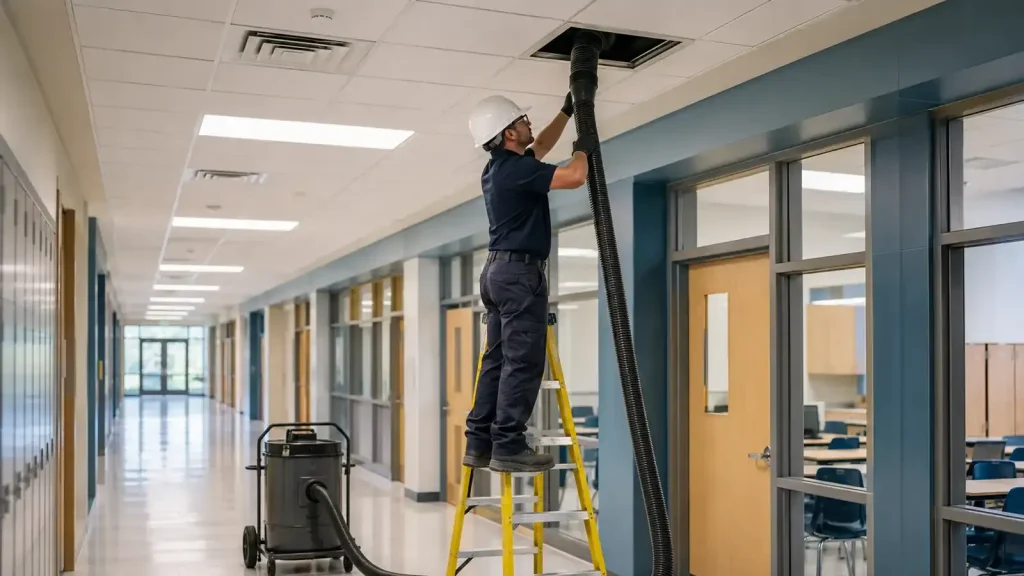
A building can look ready for reopening while its air pathway tells a different story. Desks may be cleaned, floors finished, and classrooms or offices reset, yet dust starts collecting around supply registers within days.
Occupants may report stale odors, visible particles, or rooms that seem dustier when the HVAC runs.
Seasonal pollen, extended cooling cycles, renovation dust, long periods of reduced occupancy, property turnover, and heavier foot traffic can all contribute.
The important question is not whether every dusty building needs duct cleaning. It is whether the pattern points to the HVAC system, another indoor source, or both.
That distinction matters for schools, offices, multi-tenant properties, mixed-use districts, and commercial facilities across suburban and urban communities.
Reopening changes occupancy, airflow, cleaning activity, and HVAC demand at the same time, making previously unnoticed dust conditions easier to spot.
A building that operated at reduced occupancy may suddenly have doors opening frequently, more people moving between rooms, and equipment producing heat. The HVAC system may also run longer to maintain indoor conditions.
That renewed airflow can make settled debris around returns, registers, and accessible duct surfaces more noticeable. Dust appearing near a vent does not automatically prove that the ductwork is the source, but repeated patterns deserve investigation.
The EPA reports that people spend about 90% of their time indoors, making the condition of occupied buildings particularly relevant to everyday indoor air quality.
Its guidance emphasizes source control, ventilation, filtration, and appropriate air cleaning as complementary strategies. EPA indoor air quality guidance
Spring pollen, summer humidity, extended AC use, drywall sanding, flooring replacement, ceiling work, and tenant improvements can add particles to a building.
After construction, visible housekeeping may remove surface debris while finer material remains near returns or other HVAC pathways.
A practical post-construction dust and ductwork assessment can help facility decision-makers distinguish ordinary cleanup from a system-level concern.
Need help sorting out recurring vent dust? We provide commercial duct cleaning for offices, schools, and other commercial facilities.
Our process can include negative-air equipment, HEPA filtration, mechanical agitation, and a final system check. Call 336-817-0075 to discuss the conditions you are seeing and whether commercial air duct cleaning fits the situation.
A room-by-room investigation helps you avoid treating every dust complaint as a duct problem.
Do not start with a cleaning date. Start with evidence.
The same evidence-based approach is useful after months of cooling. These signs that ducts may need attention after heavy AC use can help organize observations before deciding on service.
Duct cleaning cannot correct every indoor dust problem. Open doors, outdoor pollen, worn flooring, ceiling tiles, paper storage, housekeeping practices, construction activity, and poorly sealed building areas may all contribute.
For schools in particular, HVAC conditions can also be part of a larger facilities challenge. The U.S. Government Accountability Office estimated that 41% of school districts needed HVAC updates or replacements in at least half of their schools.
That represented about 36,000 schools when the report was issued. GAO school facilities and HVAC findings
Cleaning should not be used as a substitute for repairing damaged equipment, controlling water intrusion, correcting ventilation problems, or replacing components that have reached the end of their service life.
Condition-based indicators can help you decide whether deeper HVAC cleaning deserves consideration.
Commercial duct cleaning becomes more relevant when several observations point toward accumulated material inside the air pathway rather than normal surface dust alone.
Consider professional evaluation when you find:
For facilities preparing around academic or workplace schedules, a back-to-school air quality reset provides a useful framework for checking filters, vents, renovation history, odors, and airflow concerns before occupancy becomes heavier.
Commercial systems may serve multiple floors, zones, or shared areas. Cleaning, therefore, requires more planning than wiping visible vent covers. Access, containment, mechanical rooms, occupied spaces, and operating schedules all affect the work.
Good preparation protects occupied areas and helps facility managers coordinate HVAC cleaning with normal building operations.
Complete drywall sanding, ceiling work, flooring installation, demolition, or similar dusty projects before cleaning affected duct pathways whenever practical.
Cleaning the system and then restarting construction can introduce new material almost immediately.
Schools and offices may have limited windows for accessing classrooms, conference rooms, common areas, mechanical spaces, and tenant suites.
Our commercial scheduling can include after-hours and weekend appointments to reduce operational disruption.
Our technicians use commercial cleaning methods that include negative-air machines and HEPA-filtered vacuums, with final inspections and reporting available as part of the process.
Facilities preparing for a busier season can also use commercial duct cleaning before heavier building traffic to plan work around occupancy rather than waiting for complaints to escalate.
The EPA’s 90% indoor-time figure is a useful reminder that HVAC cleanliness belongs within a broader indoor-environment plan.
Duct cleaning can address physical buildup where appropriate, while filtration, moisture control, ventilation, housekeeping, and source control address other parts of the problem.
A short facility checklist makes conversations with HVAC cleaning professionals more specific and useful.
Before requesting commercial duct cleaning:
The GAO finding that 41% of districts reported substantial HVAC update needs also reinforces an important distinction for educational facilities: cleaning and mechanical repair solve different problems.
If equipment is leaking, damaged, malfunctioning, or unable to provide required ventilation, involve the appropriate HVAC or building professional.
Suspected mold or microbial contamination also calls for caution. Avoid disturbing unknown growth or applying chemicals without understanding the underlying moisture condition.
Qualified professionals should evaluate persistent water intrusion, suspected hazardous material, or significant microbial concerns.
Recurring dust deserves investigation, but the right response depends on where the material originates and what changed before reopening.
One complaint may come from ordinary housekeeping. Repeated dust near HVAC openings, visible internal debris, renovation residue, or complaints tied closely to blower operation deserve a closer look.
We serve residential and commercial communities across the region, including suburban properties, commercial corridors, multi-tenant buildings, mixed-use districts, older properties, and renovation-heavy neighborhoods. You can also review our broader air duct and vent services through Brookstown Duct Cleaning.
If your school, office, commercial property, or managed facility is facing persistent dust complaints after reopening, call Brookstown Duct Cleaning at 336-817-0075.
We can discuss the conditions you have documented, evaluate whether commercial duct cleaning is appropriate, and help you plan the work around building access and occupancy.
Not automatically. Dust near a register may come from normal room activity, outdoor particles, nearby construction, or material inside the HVAC pathway. Look for repeated buildup, visible internal debris, and a clear connection between dust release and HVAC operation before deciding on cleaning.
Higher occupancy increases foot traffic, door activity, housekeeping demands, and HVAC runtime. Settled particles may also become more noticeable once air circulation increases. Inspect filters, returns, registers, recent renovation areas, and complaint patterns before identifying the cause.
It may be appropriate when drywall dust, insulation fibers, flooring debris, or similar material enters returns or settles in accessible HVAC pathways. Finish active dust-producing work first so a recently cleaned system is not immediately exposed to new construction debris.
No. Cleaning should respond to building conditions rather than the calendar alone. Inspect accessible duct areas, filters, registers, recent construction activity, recurring odors, and documented dust complaints. Facilities with damaged HVAC equipment may need mechanical work instead.
No. Cleaning removes accumulated material from appropriate HVAC surfaces, but it does not correct an improperly designed ventilation system, damaged equipment, failed controls, or insufficient outdoor-air delivery. Those conditions require evaluation by qualified HVAC or building professionals.
Record affected rooms, complaint timing, visible dust, vent conditions, filter status, recent construction, moisture concerns, and whether problems occur when the HVAC starts. Photos and a zone-by-zone complaint map can make a professional assessment more focused.
Track when and where the odor occurs and check for visible moisture or water damage. A musty smell alone does not confirm mold. Persistent moisture, visible growth, or suspected microbial contamination should be evaluated appropriately before cleaning or sanitizing decisions are made.
Commercial cleaning can often be planned around low-occupancy periods. We offer flexible commercial scheduling, including after-hours and weekend appointments, which can help reduce interference with offices, classrooms, shared spaces, and normal facility operations.
Wiping or vacuuming accessible register surfaces can remove visible surface dust, but it does not reach material deeper in the duct system. Avoid pushing household tools deep into ductwork. Repeated internal buildup deserves professional evaluation rather than aggressive DIY cleaning.
Map complaints by unit, floor, suite, or HVAC zone. Determine whether several occupants connected to the same system report similar conditions. Also review tenant improvements, turnover work, filters, moisture issues, and common-area maintenance before selecting a cleaning response.
Not automatically. Physical cleaning and sanitization serve different purposes. Any treatment should match the condition found, and moisture or contamination sources should be addressed first. Avoid treating sanitization as a substitute for removing debris, repairing leaks, or correcting building problems.
Talk to a locally owned Winston-Salem team for a clear quote and a thorough, clean job.
Plan commercial duct maintenance from building use, inspection findings and a clear scope. Learn what facility managers should ask before…
Read More »During professional air duct cleaning, expect a scope walkthrough, access and equipment setup, cleaning of the agreed pathways, and a…
Read More »Learn what drives commercial duct cleaning costs, how to build a year-end budget, and what facility managers should compare before…
Read More »