How Many House Fires Are Caused by Dryers? (NFPA Stats Explained)
Understand dated NFPA dryer-fire estimates, why washer totals differ and how to use statistics without presenting historical figures as 2026…
Read More »
Dryer Vent Cleaning
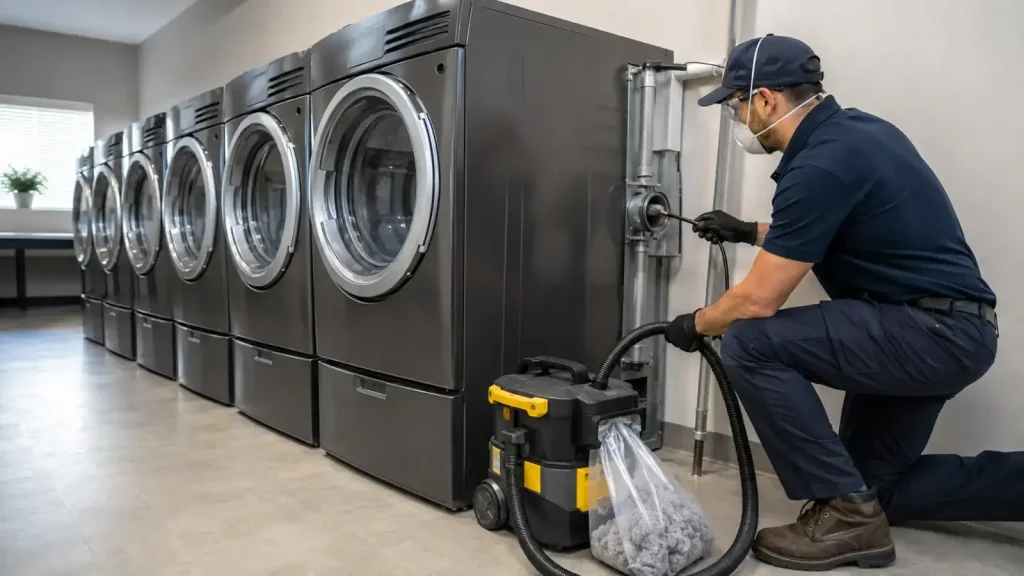
Laundry demand rarely increases by one load at a time. Property turnover can put several machines back into service at once. Seasonal routines add towels, heavier clothing, linens, uniforms, and tenant laundry.
Mixed-use and multi-tenant properties may also see machines run back-to-back for longer portions of the day.
That workload matters because lint does not stay only on the lint screen. Material that moves into the exhaust pathway can collect inside bends, longer vent runs, connections, and exterior terminations.
A system that seemed acceptable during lighter use may begin showing restricted airflow once laundry volume rises.
For property managers, landlords, facility decision-makers, and business owners, commercial dryer vent cleaning is therefore best treated as planned maintenance rather than a response to a failed dryer.
Higher demand can expose airflow restrictions that were less noticeable when dryers ran fewer cycles.
A dryer must move heat and moisture through its exhaust pathway. Increased usage gives an existing restriction fewer quiet periods and puts more load through the same vent system.
Property turnover is an especially useful checkpoint. Cleaning crews, incoming occupants, maintenance teams, and existing tenants may all create concentrated laundry demand.
A turnover dryer vent safety review can help property teams identify inherited drying problems before a new occupant assumes slow performance is normal.
The same logic applies to apartment laundry rooms, hospitality-related laundry areas, mixed-use properties, and other facilities where several loads may run in succession.
The most important warning signs often appear as routine operational complaints before anyone treats them as vent problems.
One of the easiest problems to overlook is a dryer that simply seems slow. Staff or tenants may respond by running another cycle instead of reporting the change.
Longer drying can have several causes, including appliance problems, but restricted exhaust airflow deserves attention. The NFPA’s clothes dryer safety guidance recommends keeping exhaust venting unrestricted and removing accumulated lint from the vent pathway.
Track drying complaints by machine rather than by laundry room. A repeated second-cycle complaint on one dryer provides more useful information than a general statement that the laundry room is busy.
Cleaning lint screens is essential, but it does not clean the full exhaust route. Fine lint can travel beyond the filter and accumulate where normal housekeeping cannot reach.
This distinction becomes more important in shared laundry areas. Professional dryer vent cleaning addresses the exhaust pathway rather than only the visible lint trap area.
The Massachusetts Department of Fire Services also advises that commercial dryer vents should be cleaned regularly, particularly because commercial dryers receive substantial use and may involve common venting arrangements.
Laundry rooms naturally become warm, so unusual heat can be easy to dismiss. Property teams should pay attention when the dryer, nearby surfaces, or room seem noticeably hotter than their normal operating pattern.
Restricted airflow can interfere with the movement of heat and moisture outdoors. Burning odors, smoke, sparking, gas odors, or abnormal overheating should not be treated as routine vent-cleaning symptoms. Stop using affected equipment and involve the appropriate qualified professional.
If laundry volume is about to increase, you can schedule commercial dryer vent cleaning before those warning signs become mixed into a much busier maintenance queue.
Need the exhaust system evaluated before seasonal or turnover demand rises? We provide dryer vent cleaning for residential and commercial properties across the region. Call 336-817-0075 to discuss your property with Brookstown Duct Cleaning.
Shared and multi-unit systems require property-level thinking rather than treating every complaint as an isolated appliance issue.
Keep basic maintenance notes for each machine. Record:
The goal is not to diagnose the equipment yourself. The record helps distinguish recurring vent-related patterns from individual appliance failures.
Commercial and multi-tenant properties may involve longer vent runs, concealed sections, upper-level terminations, or spaces that require coordination with occupants.
Planning before demand rises gives managers more control over access and scheduling. That same approach is useful during the seasonal window discussed in dryer vent cleaning before heavier fall use.
Our commercial services can also be scheduled during night or weekend hours when limiting disruption is important.
Dryer exhaust, HVAC ductwork, construction dust, and odor sources are separate systems and should be evaluated accordingly.
A slow dryer does not automatically indicate an HVAC problem. Dryer vent cleaning addresses the pathway carrying lint, moisture, and exhaust outdoors. HVAC duct cleaning addresses supply and return air pathways.
Property managers should separate these concerns:
Renovation-heavy properties can face several maintenance issues at the same time. A post-construction cleanout review can help distinguish building dust concerns from dryer lint buildup.
Humidity can also make damp laundry and stale building odors more noticeable. That does not prove a dryer vent or HVAC problem. Source-focused investigation remains important when humidity makes indoor odors more apparent.
Simple observations and maintenance records can help you act before laundry demand makes existing problems harder to isolate.
Before a known busy period:
Across suburban communities, commercial corridors, multi-tenant properties, mixed-use districts, and year-round residential properties, preventive planning can reduce uncertainty when laundry demand changes.
Maintenance is easier to coordinate when you act on airflow and lint concerns before machines enter their busiest period.
Heavy usage should not be the first test of an uncertain dryer exhaust system. If drying times are increasing, lint is appearing near outlets, or a shared laundry area is approaching a high-volume period, address the exhaust pathway before repeated cycles become the new normal.
At Brookstown Duct Cleaning, we are locally owned and serve residential and commercial properties within a 30-mile radius.
Our trained technicians use professional-grade tools for dryer vent cleaning, and our process includes assessment, vent cleaning, airflow testing, reconnection, and a final walkthrough.
Existing lint buildup or airflow restrictions may become more noticeable once dryers begin running additional loads. Planning maintenance beforehand also gives you more control over access and scheduling. It is easier to investigate a slow dryer before a shared laundry room enters a high-demand period.
Watch for longer drying times, hot but damp laundry, excess heat, visible lint near vent openings, weak exterior airflow, or repeated dryer shutdowns. No single sign proves the cause. Appliance faults and damaged vent components can create similar symptoms and may require another qualified trade.
No. The lint filter is an important first line of maintenance, but some material can move into the exhaust route. The concealed duct, bends, connections, and exterior termination cannot be maintained simply by cleaning the screen after each load.
The right schedule depends on equipment use, system configuration, laundry volume, and observed conditions. High-use shared laundry environments may need closer monitoring than lightly used equipment. Follow equipment guidance and use professional evaluation when performance or airflow changes.
No. Slow drying is useful evidence, but maintenance does not need to wait for a performance complaint. Turnover periods, expected seasonal demand, known heavy use, or an uncertain maintenance history are practical times to review dryer exhaust conditions.
Restricted exhaust airflow can contribute to heat and moisture remaining around the dryer instead of moving outdoors as intended. However, unusual heat may also indicate an appliance problem. Severe overheating, smoke, burning odors, sparking, or gas concerns require immediate safety attention.
Not necessarily. Track complaints and operating changes by individual machine first. Properties may have separate vent routes, shared components, or different appliance conditions. A qualified assessment can determine which portions of the system require cleaning, repair, or further investigation.
No. Dryer vents move heat, moisture, lint, and exhaust away from dryers. HVAC ducts distribute conditioned air through a building. A property can need one service without needing the other, so symptoms should guide the maintenance decision.
Staff can document drying times, clean lint filters, note unusual heat or odors, observe accessible vent terminations, and look for visible lint around the appliance. Avoid opening electrical components, moving gas connections, or accessing unsafe roof-level or concealed vent sections.
Renovations can introduce dust and debris throughout a property and may also change access around appliances or vent routes. Keep dryer exhaust concerns separate from HVAC construction dust. Once work ends, review both systems according to the conditions actually observed.
Stop operating the affected dryer. Do not keep running test loads to determine whether the odor disappears. Burning smells, smoke, sparking, gas odors, carbon monoxide alarms, or severe overheating should be treated as safety concerns and referred to the appropriate qualified professional.
Yes. Our verified commercial scheduling includes night and weekend hours to help limit disruption. Property managers should still plan access in advance when laundry rooms, individual units, upper-level vent terminations, or other controlled areas need to be reached.
Talk to a locally owned Winston-Salem team for a clear quote and a thorough, clean job.
Understand dated NFPA dryer-fire estimates, why washer totals differ and how to use statistics without presenting historical figures as 2026…
Read More »Plan dryer vent maintenance using manufacturer guidance, laundry use, route condition and warning signs. Learn what a useful service record…
Read More »Understand dryer lint and exhaust concerns, recognize warning signs and learn why cleaning, repairs and safe appliance use all belong…
Read More »