How Many House Fires Are Caused by Dryers? (NFPA Stats Explained)
Understand dated NFPA dryer-fire estimates, why washer totals differ and how to use statistics without presenting historical figures as 2026…
Read More »
Dryer Vent Cleaning
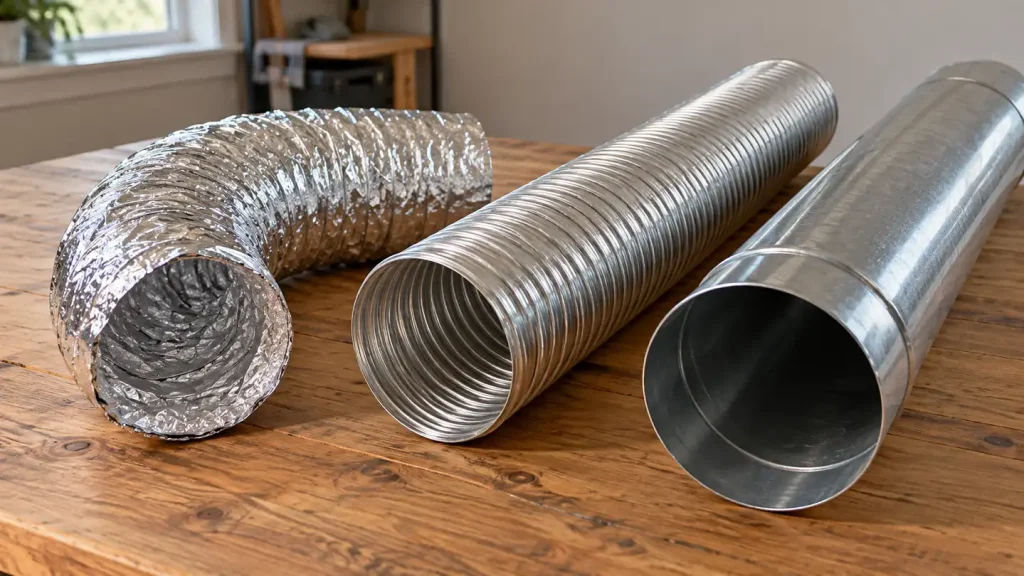
Flexible foil, semi-rigid and rigid dryer vent materials are not interchangeable simply because they connect to similar-looking openings. Their suitability depends on where they are used and the installation requirements.
Before choosing a replacement, consult the appliance instructions and an appropriate installer. This guide explains the questions to ask rather than providing a universal approval for a product category.
The visible connection behind a dryer serves a different part of the arrangement from a concealed line through walls or ceilings. A material acceptable for one location should not automatically be carried into another.
Ask the installer to identify both parts. Keep the appliance specification and any applicable installation requirements with the quote so the product choice can be checked.
A package may call a product dryer venting without explaining every permitted use. Check the exact product and installation location against the appliance instructions and applicable requirements.
Do not approve a material based only on flexibility or a low price. Ask how it will remain properly arranged when the dryer is moved into its final position, and whether the product is appropriate for that transition.
A semi-rigid connector is not immune to poor clearance or handling. The shape after the appliance is positioned matters. A suitable part can still be arranged badly in a tight space.
The installer should account for bends, connections and maintenance access. A replacement should not become a recurring compressed section that needs the same cleaning without layout correction.
Material choice is only part of the installation. A rigid route still needs suitable connections, termination and layout. Damaged or disconnected sections require assessment and correction.
Do not treat a material upgrade as proof that a concealed line is clear. If its history is uncertain or drying problems persist, discuss inspection and maintenance separately from replacement parts.
Do not guess tubing diameter from a wall opening or substitute a smaller pipe to fit a difficult space. Use the specified dimensions and an installer who can assess the complete arrangement.
If you are asking whether a three-inch pipe can be used, the answer requires the particular equipment and applicable requirements. This article does not authorize that substitution.
Ask for the product description, location of use, reason for replacement and final connection plan. Clarify whether cleaning the existing route and checking the outdoor termination are included.
Keep utility work separate. Do not move a gas-connected appliance or alter unfamiliar electrical connections to install a new vent part yourself.
For dryer vent cleaning questions, call Brookstown Duct Cleaning at (336) 817-0075. Ask whether lint removal fits the condition or whether an installation provider should first address an unsuitable or damaged arrangement.
Evaluate the exact product, installation location and appliance requirements. Do not treat all flexible products as universally acceptable or interchangeable with permanent ductwork.
No. They serve different parts of the exhaust arrangement. Confirm the suitable material and installation method for each location.
No. Clearance, handling and final positioning still matter. A suitable product can be compressed or connected improperly in a tight laundry space.
No. The route and termination still need appropriate inspection and maintenance. Material choice does not establish that the line is free of debris or damage.
Do not make an improvised substitution. Use the equipment specification and applicable requirements, with an installer who can assess the route.
No. That question depends on the specific equipment and installation requirements. Obtain an appropriate assessment rather than relying on a general article.
The transition shape can change when the appliance is pushed into place. Confirm that final clearance does not leave it crushed or distorted.
Ask which tasks are included and why each is needed. New parts do not automatically address lint or defects farther along the route.
Do not disturb unfamiliar fuel connections while changing vent parts. Arrange qualified assistance for utility-related handling.
Call Brookstown at (336) 817-0075 to discuss exhaust cleaning. Ask for installation defects to be identified separately so the appropriate corrective provider can be chosen.
Talk to a locally owned Winston-Salem team for a clear quote and a thorough, clean job.
Understand dated NFPA dryer-fire estimates, why washer totals differ and how to use statistics without presenting historical figures as 2026…
Read More »Plan dryer vent maintenance using manufacturer guidance, laundry use, route condition and warning signs. Learn what a useful service record…
Read More »Understand dryer lint and exhaust concerns, recognize warning signs and learn why cleaning, repairs and safe appliance use all belong…
Read More »